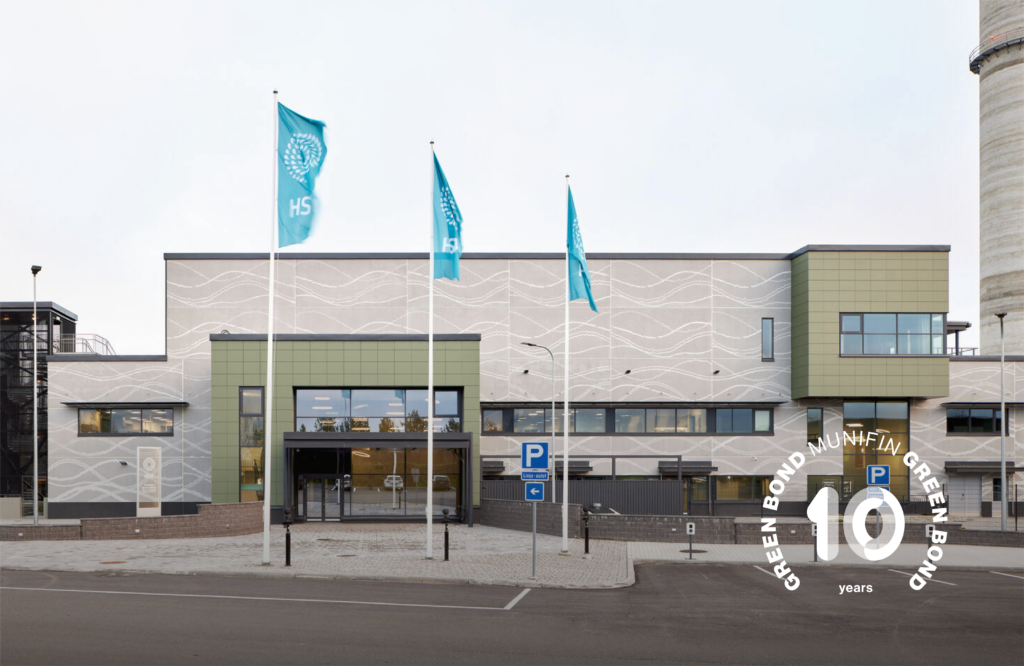
The Blominmäki wastewater treatment plant is a textbook example of a project that builds a more sustainable future. The plant’s ambitious targets have already been exceeded during its first years of operation. As part of the 10th anniversary of green bonds, MuniFin is showcasing some of the most insightful and impactful green finance cases from the past decade.
The Helsinki metropolitan area is the most densely populated region in Finland, and it continues to grow. This growth translates to an increased need for wastewater treatment capacity, which is the purview of the Helsinki Region Environmental Services Authority, known to the capital region’s residents as HSY.
HSY recognised that the old wastewater treatment plant in the Suomenoja district in Espoo had served the region for nearly 60 years. Espoo is Finland’s second-largest city, directly bordering Helsinki and a major part of the capital region. Wastewater treatment began in Blominmäki in November 2022. In practice, Blominmäki is a biorefinery that operates according to the principles of the circular economy, wastewater being its raw material. The water flows in continuously and is treated for further use: the end products are treated wastewater, biogas, and compost and soil products.
The state-of-the-art plant employs around 20 people who work mostly in day shifts; the plant’s processes and functions are largely automated and operations run around the clock, every day of the year.
Ambitious targets reached
The project has been one of Finland’s most significant environmental protection investments, making it a natural fit for green finance from MuniFin. The Blominmäki plant reduces the emissions load on the Baltic Sea, one of the most polluted seas in the world.
The plant’s substantial treatment capacity adds to the project’s impact. When applying for green finance, HSY defined that the Blominmäki plant would remove 98% of phosphorus and 90% of nitrogen from wastewater.
“The targets we set are considerably stricter than those required by the environmental permit. Even so, we have managed to exceed them, and we have managed to get the plant performing even better than these demanding targets”, says Kristian Sahlstedt, Department Director of Wastewater Treatment at HSY.
In 2025, the Blominmäki wastewater treatment plant already removed 99% of phosphorus and 95% of nitrogen from wastewater. In addition to its high treatment performance, the plant is close to being self-sufficient on energy. In terms of heating, the plant’s self-sufficiency is already a full 100%; on electricity, the self-sufficiency currently stands at 58% with HSY targeting 70%.
“I am confident that we will reach this target. Our electricity self-sufficiency has grown continuously and it will improve further as we fine-tune the process”, Sahlstedt says.
Overall, the plant’s environmental impacts are undeniable, the most significant being the improved nutrient removal. Thanks to Blominmäki, the nutrient load from the Helsinki region’s wastewater treatment to the Baltic sea is at a historically low level. The total nitrogen load discharged from HSY’s to the sea has decreased by as much as 54% and the phosphorus loadby more than 10%.
The project has also helped accelerate HSY’s environmental targets. The largest single factor in HSY’s climate footprint is the nitrous oxide emissions generated in wastewater treatment. Thanks to the advanced plant, monitoring and managing these emissions is significantly easier than before. Improving energy efficiency and protecting biodiversity have also been taken into account at Blominmäki.
There’s room to expand – underground
The Blominmäki facility has been built entirely underground, within the bedrock. This has several benefits: for one, the plant’s equipment and operations are not exposed to weather and seasonal changes, meaning fewer technical problems and more occupational safety.
Wastewater treatment happens at 35–45 metres below ground level. Together with the facility’s 100-metre chimney, this ensures there’s little to no disturbance to local residents, the surrounding nature or the landscape. The plant cannot be seen, heard, or smelled.
“Building treatment plants into rock caverns is a Nordic speciality, and visitors come from around the world to learn about them. What also interests many in Blominmäki is the scale of the project. Instead of building completely new treatment plants, it is more common to expand existing ones”, Sahlstedt says.
Blominmäki still has room for expansion. At present, the plant covers an area of around 10 hectares and treats the wastewater of approximately 400,000 residents, with enough capacity for around 500,000 residents. The growing Helsinki metropolitan area was taken into account at the planning stage: there’s space reserved in the cavern system for an expansion, should the facility at some point be able to serve an even larger population.
“Everything extra that goes down the drain in people’s homes ends up at our pumping stations and wastewater treatment plants, so we hope people will not use the sewer as a rubbish bin. We do our part and hope the residents will do theirs. A more sustainable everyday life is built together”, Sahlstedt sums up.