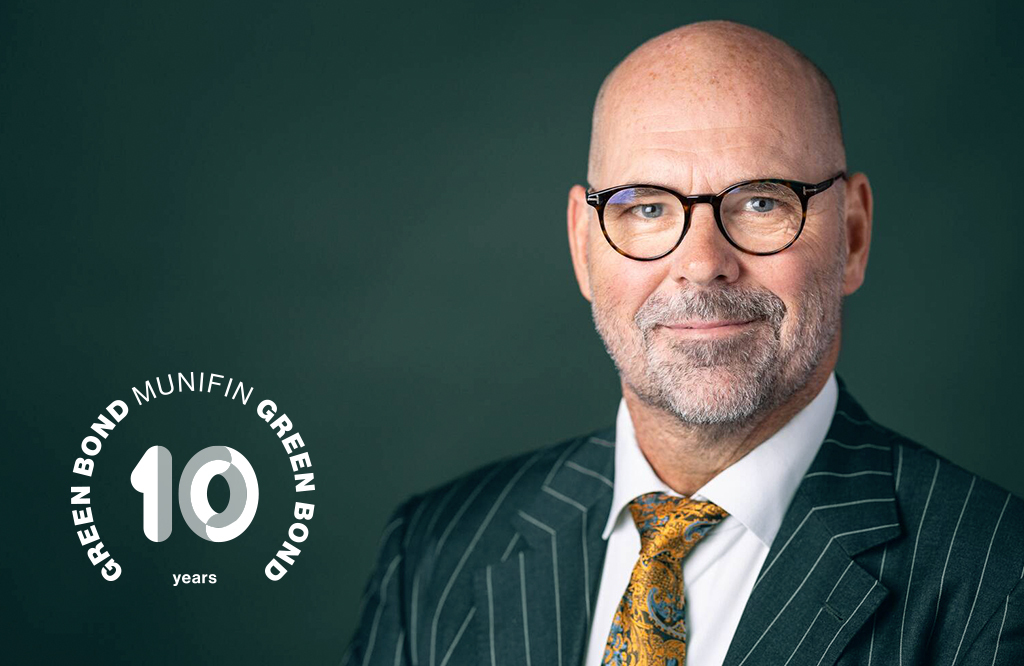
SEB’s Mats Olausson sees the next phase of sustainable investment taking shape around water, nature and biodiversity, circularity, and civil defence. For MuniFin and other Nordic issuers, the opportunity lies not only in new instruments, but in using established frameworks to greater effect.
This year, MuniFin celebrates ten years as a green bond issuer. Over this period, green bonds have moved from niche to mainstream in Europe, particularly in the Nordics, while social and sustainability-linked bonds have emerged alongside them.
SEB acted as MuniFin’s lead sustainability advisor in 2016, when MuniFin developed its first Green Bond Framework and prepared for the first green bond issuance. SEB’s Senior Sustainability Manager Mats Olausson now regards the green bond market’s evolution as a combination of voluntary standards, regulation and investor learning.
“The voluntary Green Bond Principles forced asset managers to examine what eligibility thresholds meant in practice, while the EU’s regulated framework has since added consistency and simplicity,” Olausson says.
At the same time, investors now assess the issuer as well as the financed assets, drawing heavily on ESG data, ratings and second-party opinions.
This is where the Nordic countries retain a distinctive advantage, Olausson says. Harmonised impact reporting, experienced investors and a deep issuer base have created both credibility and high expectations.
“Europe stands out globally, and within Europe the Nordics stand out. Sweden and Finland are seen as global leaders. The Nordics are thought leaders in impact reporting, and that is well recognised by the investor community.”
“MuniFin is a prime investment target because it is of exceptionally high quality. The green and social bond frameworks and impact reporting are already state of the art,” Olausson says. He sees potential for introducing new themed products within MuniFin’s existing frameworks and reporting practices.
Finland’s goal of being net-zero in 2035 is one of the most ambitious climate targets in the world, and MuniFin has a huge role in supporting it, Olausson notes.
“MuniFin represents a very large proportion of Finnish society. Through sustainable finance and the dialogue MuniFin has with its clients, it can make a major contribution.”
Olausson believes that the next growth areas in sustainable investment are likely to be thematic. Climate considerations are already embedded in the expectations Nordic financial institutions place on clients, allowing adjacent risks and opportunities to attract more attention.
SEB has recently focused its sustainability efforts on water, biodiversity and circularity. Civil defence is another emerging field. Resilient societies and economies are prerequisites for long-term profitability, and transparent financing can help investors distinguish civil preparedness from military expenditure.
This year, MuniFin is celebrating its tenth anniversary as a green bond issuer. In this series of articles, we speak with leading experts from the partner banks that have supported MuniFin’s green bond issuances. Their expertise and valued contribution have been instrumental in helping MuniFin establish its position as an international pioneer in the green bond market.