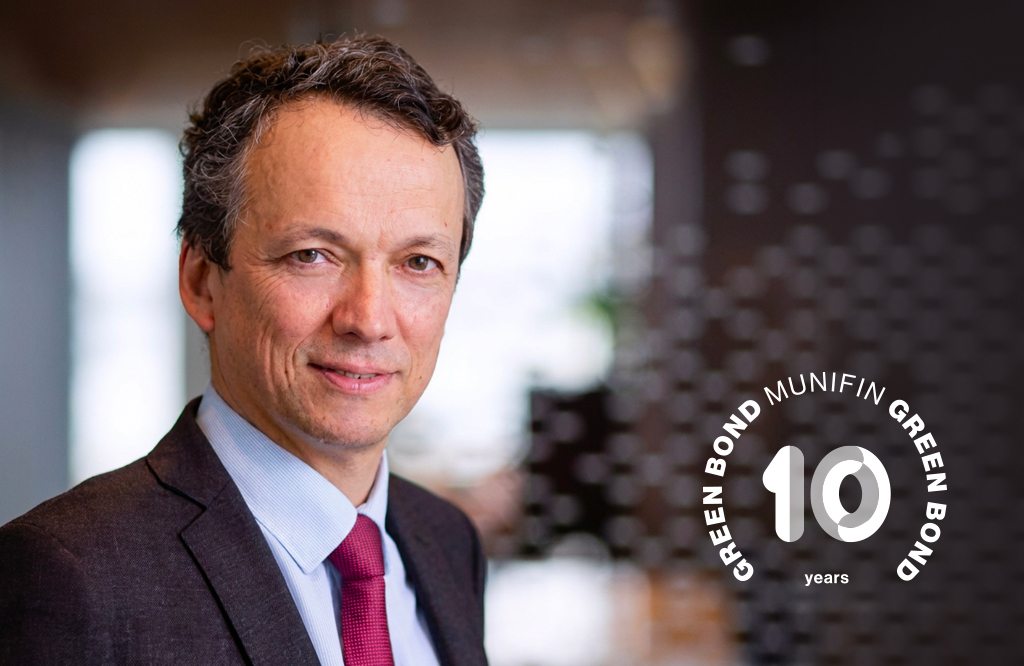
Crédit Agricole CIB’s Tanguy Claquin explains why sustainable bond markets now need practical regulation, accessible investor data and credible issuers capable of turning ambition into measurable impact.
MuniFin issued its first green bond ten years ago, and Crédit Agricole CIB has been one of its closest and longest-standing partners in arranging green bond issuances throughout the decade. With a 17-year history in green bonds, Crédit Agricole CIB sees sustainable investment as a long-term strategic commitment, says Tanguy Claquin, Global Head of Sustainable Banking at Crédit Agricole CIB.
That consistency matters in a sustainable bond market whose centre of gravity has moved decisively towards Europe and Asia. US issuance was already modest by European standards and has contracted further over the past two years, while activity elsewhere has proved more resilient, Claquin estimates.
For Claquin, the defining change of the past decade in the sustainable investment market has been the rise of regulation.
“Sustainable bond markets were originally shaped chiefly by issuers and investors, with voluntary best practice filling the gaps. Taxonomies and disclosure regimes now seek to define what qualifies as green and how issuers should evidence it.”
The task ahead is not to reverse that development, but to make the rules easier to apply without diluting their integrity.
Investor expectations have evolved in parallel. Sustainable credentials must be robust, but the supporting information must also be readily accessible and comparable.
“Investors need something strong, credible and simple,” Claquin says. Standardisation reduces the time investors spend hunting for data and allows them to focus on the quality of the assets and the issuer.
Green bonds do not replace scrutiny of an issuer’s overall sustainability profile; rather, they give responsible investors an additional instrument for directing capital towards a defined part of its balance sheet.
Nordic investors paved the way – MuniFin has become a reference issuer
The Nordic countries have been instrumental in building the sustainable investor base. Claquin traces the market’s early momentum to the Nordics, alongside the Netherlands and France.
“The sustainable bond market was born thanks to the demand in the Nordic countries,” he says. “The Nordic countries are still very important for this market.”
Within Finland, Claquin identifies MuniFin as the benchmark sustainable issuer. The Finnish sovereign has not entered the green bond market, leaving MuniFin’s regular issuance to provide investors with a dependable reference point.
MuniFin’s framework also stands out among local-authority financing institutions for linking bond proceeds to the assets ultimately financed by municipalities. Investors have come to appreciate MuniFin’s efforts to show what lies behind each green or sustainable loan. That requires data collection on projects ranging from public transport to social infrastructure.
“MuniFin has taken the position of the reference issuer in Finland, with strong commitment and regular issuance,” Claquin says.
Looking ten years ahead, Claquin expects simpler implementation of the European taxonomy and the European Green Bond Standard to support higher issuance volumes and dedicated investment funds.
Yet scale alone is not the objective. If every bond were labelled green, the label would cease to distinguish the investments most capable of advancing the transition, Tanguy Claquin remarks.
“Recent extreme European summers have heightened the sense of urgency around achieving sustainability goals, while the world remains off track to achieve net zero. For issuers, the message is clear: investors will reward credible ambition and evidence that proceeds are financing tangible change.”
This year, MuniFin is celebrating its tenth anniversary as a green bond issuer. In this series of articles, we speak with leading experts from the partner banks that have supported MuniFin’s green bond issuances. Their expertise and valued contribution have been instrumental in helping MuniFin establish its position as an international pioneer in the green bond market.