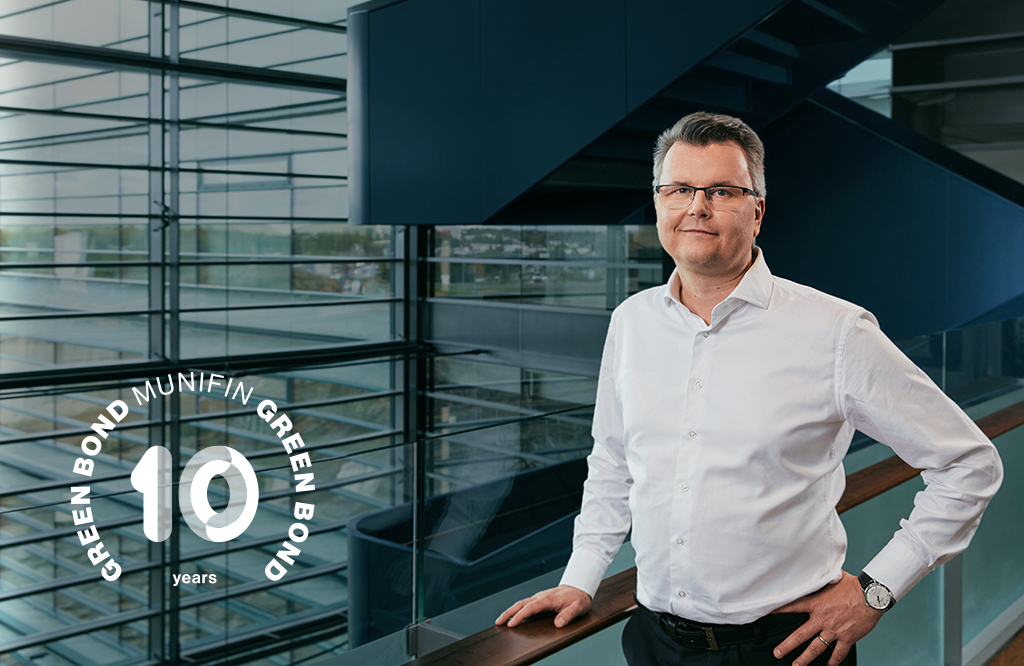
Energy security and the high cost of fossil fuels are now driving the green transition alongside climate targets. According to Danske Bank’s Samu Slotte, green investment continues to grow, but investors are demanding more compelling evidence of sustainability across bond issuers’ operations.
This year marks MuniFin’s tenth anniversary as a green bond issuer. The market has matured rapidly over that period. The first green bonds came to market just before the financial crisis, but growth only gathered pace in the early 2010s.
“Nordic issuers and investors played a pivotal role in developing the market. The initial criteria emerged through market-led self-regulation, with the EU Taxonomy subsequently introducing a regulatory framework alongside them,” says Samu Slotte, Managing Director and Head of Sustainable Finance, Defence and Advisory at Danske Bank, reflecting on the market’s evolution.
Investors’ approach to sustainability has also evolved over the past decade.
“The market has moved beyond purely ethics-based exclusion screening towards thematic investing and ESG integration. Going forward, allocating proceeds to green projects will not be enough for all investors. Increasingly, they are assessing the issuer’s overall profile, strategy, risks and opportunities, as well as the credibility of its transition plan.”
The Nordics have superpowers for the green transition
Demand for green bonds is underpinned in particular by funds whose mandates restrict them to green investments. Green bonds will retain their role, given the vast amounts of capital needed to mitigate climate change. Energy investment, building refurbishment and transport infrastructure upgrades are all a natural fit for bond financing, Samu Slotte says.
“The Nordics have a competitive advantage here. Low-carbon electricity generation and an energy-efficient building stock provide a strong foundation for new projects. The region also has a rarely discussed superpower: district heating networks,” Slotte says.
Slotte does not see the Nordic countries as competing with one another for investment either; rather, they benefit from collaboration. An integrated electricity market, interconnected grids and complementary industrial structures make the region an attractive destination for investment in green transition projects.
MuniFin has already established a strong presence in the capital markets as a green bond issuer.
“MuniFin plays a vital role in supporting the green transition in Finland’s municipal sector. As the market evolves and investors increasingly expect credible overarching strategies from sustainable issuers, institutions such as MuniFin may be particularly well placed. MuniFin’s business as a whole is closely aligned with society’s transition to sustainability, rather than this alignment being confined to individual green bond issues.”
Energy security has become a new driver of investment
In Samu Slotte’s view, geopolitical shifts will be the defining factor in the next phase of the green bond market’s development. Climate policy has become less prominent in public debate, but the economic and energy security drivers of the energy transition have only strengthened.
“Europe’s and China’s reliance on imported fossil fuels makes energy availability, affordability and self-sufficiency strategic priorities. This has accelerated investment in electrification, renewables, grids, storage and energy efficiency – and will continue to do so.”
According to Slotte, the war in Ukraine has been a key catalyst for Europe’s green transition. The loss of Russian pipeline gas has pushed up energy costs in some parts of Europe, making dependence on fossil fuels a competitiveness issue as well. Industrial companies in continental Europe have had to source expensive liquefied natural gas, even as the cost of renewable energy continues to fall.
“Climate targets, energy security and energy prices are now steering Europe towards a lower-carbon economy. Falling solar power and battery costs have strengthened the economic case for the transition. Rather than bringing green investment to a halt, geopolitics has reshaped the investment rationale and accelerated the timetable for moving away from fossil fuels,” Slotte says.
This year, MuniFin celebrates ten years as a green bond issuer. In this series of articles, we interview leading experts from the partner banks that have supported MuniFin’s green bond issuances. Their expertise and valued contribution have been instrumental in helping MuniFin establish its position as an international pioneer in green bond market.